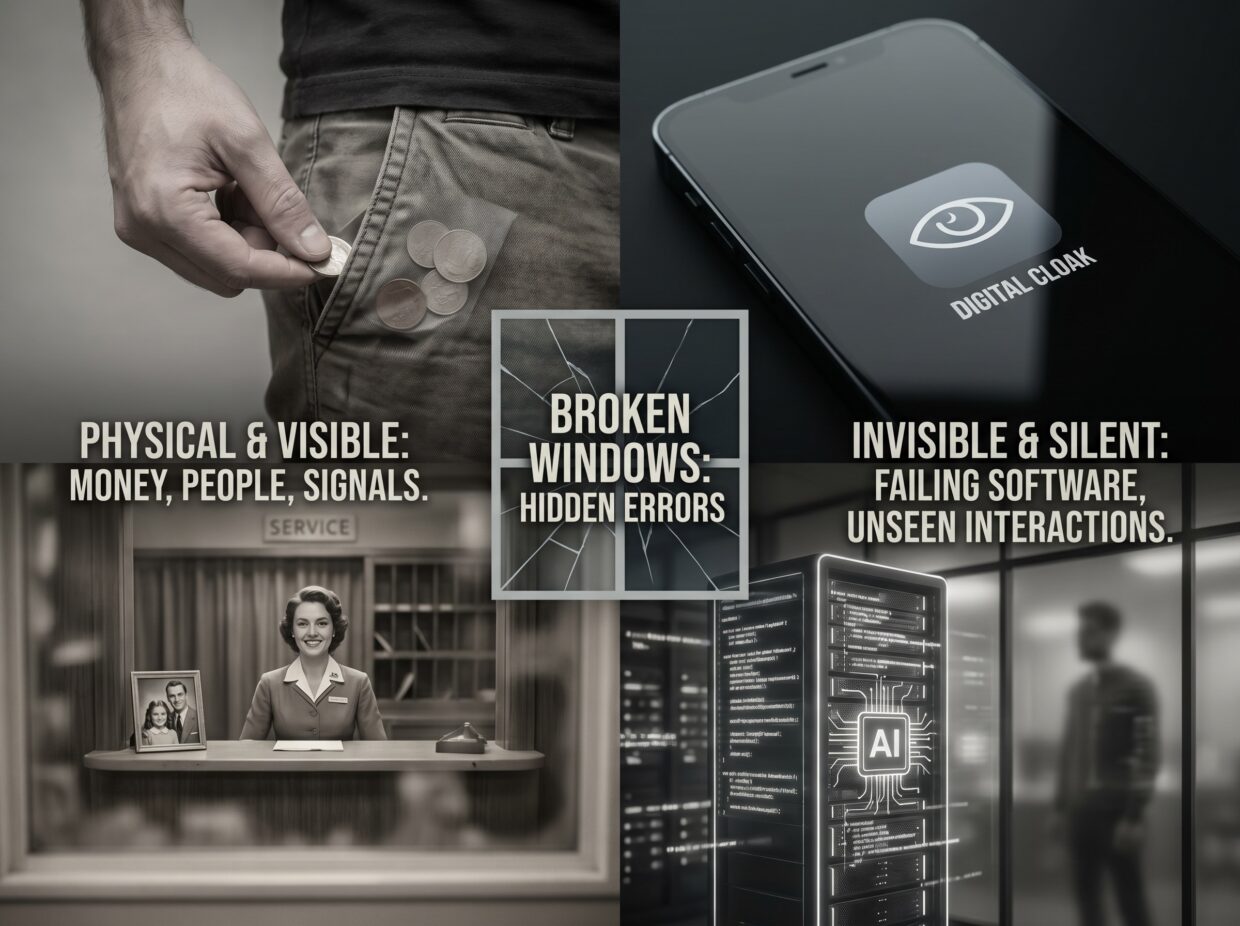
Failing software under the cloak of innovation. I’ve been building software and digital products and services for 30 years now, and that digital cloak is exactly where things go wrong. It makes people invisible, makes dialogue impossible, and silences ordinary everyday people. AND NO ONE SEES IT.
Money in your pocket. Do you still have enough to quickly grab some fries? A tap on your right trouser pocket and you knew. That’s the beauty of the physical representation of money: it’s always on. But with “apps,” the sense of money disappears as soon as the app is closed, or the screen goes off. It becomes invisible until you make the effort — but then you do that less and less, which leads to never, or at least not often enough. This pattern makes us less smart.
The same applies to people in service roles. People who represent a company or a brand are a kind of memory aid, beacons of recognition, and quite literally the human face of what we can expect. And for the company, they form a dynamic system that remembers, learns, and sends signals. Software and AI can do that too, but only in theory.
The “flow” of call center software is mapped out; scale is unlimited within the beaten paths. But learning and changing are extremely difficult. That is not a natural step, but a forced one. Just like that little screen that has to be turned on to make your money visible.
And here it comes: all the awkward interactions, the shy customer, the little girl who has to do something for her dad because he no longer has legs, the lovely interactions with a happy customer, and those caused by a strange error at a partner. In software, all of that is invisible by default. Learning, being kind, truly helping, and changing yourself as well — it doesn’t happen. All signals are always invisible unless you make an effort. THAT IS THE REAL REASON WHY SOFTWARE AND AI ARE NOT ALWAYS THE RIGHT SOLUTION. You make people invisible by default, you make fallible software invisible, you make unexplored territory invisible.
And the business case? There is something called “broken windows,” a concept in software that emphasizes immediately fixing small maintenance issues so they don’t escalate out of control as they pile up, become confusing, and become interconnected. The “dashboards” of much software are focused on the performance of the software, not on where the software — the codex — goes wrong. It keeps the functioning, errors, and shortcomings of the software INVISIBLE. Not deliberately, but by default. That’s how you install a system in your company that keeps “broken windows” invisible. SO STUPID.
And now we have process mining and data mining for that… again: for optimizing what is already visible — success, the path that has been laid out — not the opportunities, not the invisible broken windows, not the impact on everything you could become, not the impact on where things have been going wrong for years.
For the NPS hunters: focus on the broken windows instead, because fans forgive; customers remember in silence.